Advertisement
What Values Does the Hajj Promote? Core Lessons Every Muslim Should Understand
Many readers search for what values does the hajj promote because they do not want only a list of rituals. They want to understand the moral and spiritual meaning behind the pilgrimage. That is an important question. A Muslim can memorize the steps of Hajj, but without understanding its values, the journey may remain external rather than transformative.
Short Answer
If you need the short answer first, Hajj promotes values such as:
- obedience to Allah
- humility
- equality
- patience
- sacrifice
- repentance
- unity of the Ummah
- gratitude
- discipline
- remembrance of the Hereafter
The rest of this guide explains how each of those values appears in the rites of Hajj.
1. Obedience to Allah
The first value Hajj promotes is obedience. Pilgrims do not design the ritual for personal convenience. They follow a sequence set by divine guidance.
This teaches a Muslim that worship is not built on preference, mood, or self-expression alone. It is built on surrender to Allah's command.
When pilgrims move from Mina to Arafat to Muzdalifah in the required order, they practice obedience in visible form.
2. Humility
Hajj strips away many markers of social status. Pilgrims wear simple clothes, stand in the same plains, and move with the same crowds. Wealth, nationality, profession, and worldly image lose their usual power.
Humility appears in Hajj through:
- simple dress
- crowded movement
- shared worship conditions
- awareness that every soul stands needy before Allah
This is one reason Hajj can deeply soften the heart.
3. Equality Among Believers
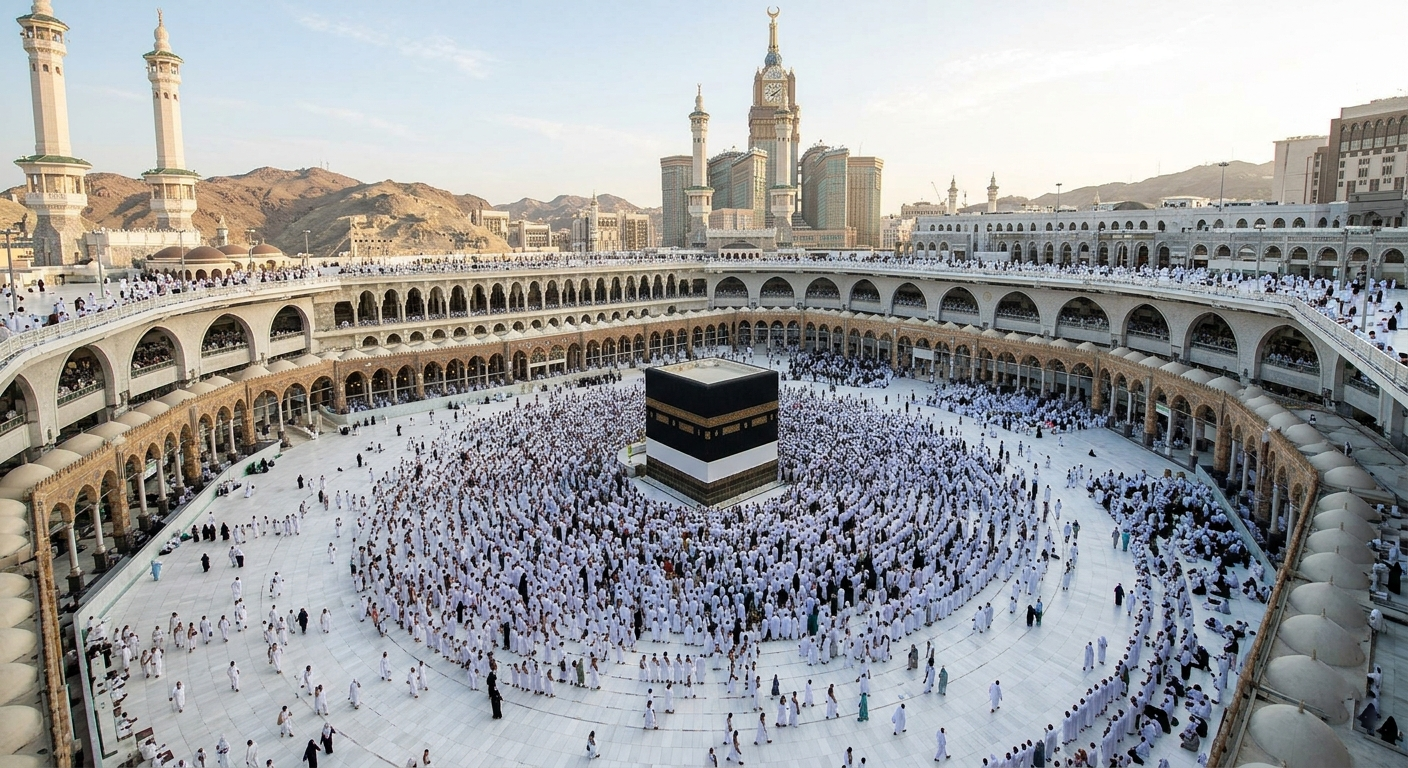
One of the clearest answers to what values does the hajj promote is equality. Pilgrims come from every race, language, culture, and social background, yet they gather in one sacred journey.
The visual lessons of Hajj are powerful:
- everyone answers the same call
- everyone follows the same rites
- everyone depends on Allah's mercy
This equality is not theoretical. It is lived in the movement of millions.
4. Patience in Difficulty
Hajj is physically and emotionally demanding. Heat, walking, waiting, crowd pressure, and changing schedules all test the pilgrim.
This is why patience is not an optional moral extra in Hajj. It is one of its central values.
Pilgrims practice patience when they:
- remain calm in crowded areas
- avoid arguments
- tolerate delays
- keep dhikr while tired
- continue worship through hardship
A patient pilgrim often gains far more from Hajj than a merely efficient one.
5. Sacrifice
Hajj teaches sacrifice in several forms:
- sacrifice of wealth to make the journey
- sacrifice of comfort and familiar routine
- sacrifice of ego and personal control
- ritual sacrifice where applicable
This value reminds Muslims that closeness to Allah often requires letting go of comfort and self-centeredness.
6. Repentance and Renewal
Hajj is also a journey of repentance. Pilgrims leave ordinary surroundings and enter a sacred sequence that encourages self-examination.
The Day of Arafah especially highlights:
- asking forgiveness
- remembering past sins
- hoping in Allah's mercy
- committing to change after returning home
This is why many Muslims see Hajj as a spiritual reset, not only a travel milestone.
7. Unity of the Ummah
When people ask what values does the hajj promote, unity must be near the top of the list. Hajj brings Muslims together across borders in one of the most visible acts of global Islamic worship.
This unity teaches that Islam is not restricted to one ethnicity, one language, or one local culture. The Ummah is broader than all of those limits.
Pilgrims witness that in real life through prayer lines, shared rites, and common purpose.
8. Gratitude
A pilgrim who completes Hajj becomes more aware of blessings that are often ignored in daily life:
- health
- safety
- wealth
- guidance
- the ability to worship
Hajj promotes gratitude because it exposes both human weakness and divine generosity.
9. Discipline and Self-Control
Pilgrims cannot approach Hajj carelessly. The rites require attention, order, and restraint. This develops discipline in:
- speech
- time management
- physical action
- emotional reactions
- spiritual focus
Hajj trains a Muslim to live with more order and more awareness.
10. Awareness of the Hereafter
The gathering of pilgrims, the plain of Arafah, the clothing of Ihram, and the atmosphere of repentance all remind many believers of resurrection and standing before Allah.
This Hereafter-awareness is one of the deepest values of Hajj. It changes how a Muslim thinks about:
- sin
- death
- accountability
- mercy
- final return to Allah
How Specific Rituals Teach Specific Values
Ihram
Teaches humility, equality, and detachment from status.
Talbiyah
Teaches obedience and response to Allah's call.
Arafah
Teaches repentance, hope, and urgency in dua.
Muzdalifah
Teaches simplicity, endurance, and trust.
Jamarat
Teaches resistance to temptation and commitment to obedience.
Tawaf
Teaches devotion, remembrance, and centeredness around Allah.
Looking at Hajj this way helps the rites feel deeply connected rather than isolated.
Why These Values Matter After Hajj
The values of Hajj should not remain in Saudi Arabia. The true test begins after the pilgrim returns home.
Questions every pilgrim should ask after Hajj:
- Am I more patient now?
- Is my prayer more serious?
- Has my character improved?
- Am I less arrogant?
- Do I remember the Ummah more often in dua?
If the answer to these questions improves, the values of Hajj are still alive.
Common Mistakes When Thinking About Hajj Values
Treating Hajj as only logistics
Planning matters, but Hajj is not merely an itinerary.
Focusing only on reward, not character
The values of Hajj should shape the believer's behavior.
Thinking values are secondary
In reality, values are built into the rituals themselves.
Limiting Hajj lessons to pilgrims only
Even Muslims who have not yet gone can learn from Hajj's values and prepare their hearts.
Hajj Values in Daily Life After Returning Home
The real test of these values comes after the journey. A pilgrim who learned patience should show more patience at home. A pilgrim who learned humility should become easier to live with. A pilgrim who learned unity should speak and act with more concern for the Ummah. This is how the answer to what values does the hajj promote becomes visible in real character.
Why These Values Matter Even Before Hajj
Muslims who have not yet gone for Hajj can still begin living by its values now. Patience, sacrifice, humility, gratitude, and obedience are not reserved only for pilgrims in Makkah. They are values every Muslim can practice while preparing for the day Allah opens the way to Hajj.
A Short Personal Values Checklist
If you want to apply the answer to what values does the hajj promote, ask yourself regularly:
- Am I becoming more obedient?
- Am I less attached to status?
- Am I more patient with people?
- Am I quicker to repent?
- Am I more aware of Allah and the Hereafter?
This turns Hajj values from theory into daily self-accountability.
Conclusion
So, what values does the hajj promote? It promotes obedience, humility, equality, patience, sacrifice, repentance, unity, gratitude, discipline, and awareness of the Hereafter. These values are not side themes. They are woven into the structure of the pilgrimage itself.
The more a Muslim understands these values, the more meaningful Hajj becomes. It is not just a sequence of places and actions. It is a school of the heart, the body, and the soul.
May Allah let every pilgrim carry the values of Hajj home and live by them long after the journey ends.
Quran and Sunnah references
- Quran 2:196 on completing Hajj and Umrah for Allah.
- Quran 3:97 on the obligation of Hajj for those able to undertake it.
- Sahih al-Bukhari and Sahih Muslim: Umrah to Umrah expiates sins between them.
Explore more
Continue Reading
Popular Umrah Guides
Umrah Guide Step by Step: How to Perform Umrah for Beginners
How to Perform Umrah Step by Step (Complete Guide)
Complete Umrah Duas Guide: All Prayers & Supplications with Arabic Text
Ultimate Umrah Packing List 2024: What to Bring & What to Leave
15 Common Umrah Mistakes to Avoid: Expert Tips for a Valid Pilgrimage
Explore Makkah & Kaaba
Qibla Direction Explained: How Muslims Face the Kaaba in Prayer
الحجر الأسود (Hajar al-Aswad): Meaning, History, and Place in Tawaf
Kaaba Door Guide: Why It Is Raised, How It Changed, and Why It Matters
Mecca Meaning in Islam: Why It Is Called Makkah al-Mukarramah
Masjid al-Haram Map Guide: How to Understand the Sacred Mosque Layout
Masjid al-Haram Guide: The Sacred Makkah Mosque at the Heart of Islam
Recommended Travel Resources
Best Umrah Packages 2025: Prices, Options & Guide
Best Umrah Packages 2026 (Affordable Options & Tips)
Economy Umrah Packages: Affordable Booking Guide for Budget Pilgrims
Umrah Package With Flights: What Should Be Included Before You Book
Air Ticket for Umrah: Flight Booking Guide, Timing, and Package Strategy
Umrah Expenses from Pakistan: Full Cost Breakdown and Booking Plan
Frequently Asked Questions
What values does the Hajj promote most clearly?
Hajj strongly promotes obedience, humility, equality, patience, sacrifice, repentance, unity, gratitude, and remembrance of the Hereafter.
Why is equality considered a major Hajj value?
Because pilgrims from different races, languages, and backgrounds gather in shared rites, simple clothing, and the same dependence on Allah's mercy.
Should the values of Hajj continue after returning home?
Yes. A key sign of benefit is that patience, humility, worship, and character continue improving after the pilgrimage.
Advertisement